 |
|
 |
Hydrogen Alpha ExplainedWhy Hydrogen? Why Alpha? |
Why Hydrogen?
The sun contains many elements but the most abundant by far is hydrogen. The visible layers (the photosphere and the chromosphere) is the only part of the sun that is cool enough for hydrogen to exist in it's atomic form and it is here that we can see the absorption and emission spectra for hydrogen.
It is helpful to think of a hydrogen atom as a small 'solar system' with the heavy nucleus as the 'sun' in the middle. This particular solar system has only one planet orbiting - ie a single electron. Due to the laws of quantum physics, this electron can only orbit the nucleus in specific orbits which are given a number n.
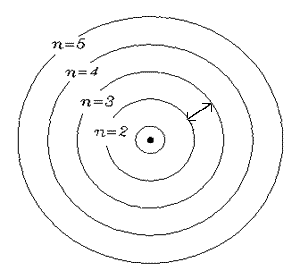 When electrons jump from the lower to the higher number orbits, they absorb a particular amount of energy and we can observe the absorption spectrum. When they fall back again they release the same amount of energy and we can observe the emission spectrum. The amount of energy absorbed or released in this way can be mathematically directly related to the wavelength at which we see the absorption and emission lines on the spectrum.
Hydrogen can absorb and emit in the ultraviolet region of the spectrum (the Lyman series) but the emissions and absorptions we see in the visible part of the spectrum are the Balmer series and occur when electrons jump from and fall to the n=2 orbit.
Why Alpha?
The Balmer series lines that we see are imaginatively call alpha, beta, gamma.... and so looking at the diagram below you can see the whole picture... The line that appears in the red part of the spectrum is created when an electron moves between the second and third orbit (N=2 and N=3) and the wavelength at which this occurs is 656nm. It is this line that is called the Hydrogen alpha line and hydrogen alpha filters are designed to block out as much of the spectrum as possible leaving only a very small bandwidth through which light can pass at the H-alpha frequency.
Hydrogen Alpha filters typically have a bandpass in the region of 0.5Å to 1Å (Å = Angstrom) where 1Å is 0.1nm.
